
No CDL Required Does Not Mean No Experience Needed
Box trucking can offer an accessible path into business. The harder question is whether drivers and owners are prepared for the responsibility that comes with the keys.
A driver can be comfortable behind the wheel of a car and still be unprepared for the first tight delivery in a loaded box truck. The turn is wider. The overhead clearance matters. The customer wants the freight inside. A vehicle is parked where the truck needs to back. The next appointment is already getting closer.
That is where the business becomes real. The challenge is no longer finding a truck or getting access to a load. It is making good decisions when equipment, freight, customers and time are all competing for attention.
Box trucking deserves to remain an accessible opportunity. People should be able to enter the industry, learn a trade and build a business without being dismissed because they are new. But the industry also needs a more honest conversation about preparation. Removing one licensing requirement does not remove the knowledge the job demands.
A June 11 FreightWaves article by Rob Carpenter raised concerns about driver qualification and oversight in lighter commercial fleets. His analysis of inspection records is the starting point for this discussion, rather than a new BTO statistical finding. We have not independently reproduced his dataset or its comparisons. Our focus is what the federal rules actually require and what responsible operators should do beyond the minimum. Read Carpenter’s original reporting [1].
The low barrier argument deserves a serious answer
There is a reasonable argument that an accessible entry path can allow people to begin operating before they understand the work. In some box-truck operations, a driver does not need a commercial driver’s license. That removes a formal licensing step that exists for heavier equipment.
BTO’s view is that this can create a preparation gap when access to the vehicle is treated as evidence of readiness. That is an argument about how the business can go wrong, not proof that every new entrant is unsafe or that licensing thresholds caused a particular crash.
Experience also needs to mean more than time served. An experienced driver can develop bad habits. A new driver can become a capable professional with instruction, supervised practice and clear standards. A CDL provides a licensing qualification; it cannot guarantee every decision a driver will make afterward.
The useful question is therefore specific: before someone operates this truck, with this freight, on this route, what has the business done to establish that the person can handle it?
What non CDL actually means
Under federal CDL classifications, a single vehicle with a gross vehicle weight rating or gross vehicle weight of 26,001 pounds or more, whichever is greater, generally falls into Class B when it is not part of a Class A combination. Combination vehicles have separate criteria. Certain passenger and hazardous-material operations can require a CDL below that weight. A truck’s box length alone does not determine the answer. FMCSA CDL classifications [2].
That matters because “26-foot box truck” describes a body length, not a complete legal classification. Operators need to know the ratings, actual weights, configuration and cargo involved. They also need the proper license under the applicable state rules.
The federal safety threshold is different. For interstate commerce, the commercial-motor-vehicle definition generally reaches vehicles with a weight rating or actual weight of 10,001 pounds or more, using the applicable vehicle or combination measure and whichever is greater. Passenger and hazardous-material criteria can also trigger coverage. 49 CFR 390.5 [3].
A non-CDL box truck can consequently still carry federal driver-qualification, medical, hours-of-service, inspection and maintenance obligations, subject to the rules and exceptions applicable to the operation. 49 CFR 391.41 [4] and 391.51 [5]. “No CDL required” is a narrow answer to one licensing question. It should never be the entire compliance plan.
A local route can still carry interstate freight
Another misunderstanding begins with the route map. A truck may remain inside one state while carrying freight that is part of an interstate movement.
FMCSA explains that interstate commerce can include transportation within one state when it is part of a movement that originates or terminates outside that state or the United States. Whether a particular warehouse-to-customer trip qualifies depends on the transportation’s circumstances, not simply whether that driver crosses a state line. FMCSA interstate and intrastate guidance [6].
For genuinely intrastate work, state requirements must be checked. For interstate work, operators must determine which federal requirements and exceptions apply. Neither “we stay local” nor “the truck is small” is a reliable substitute for that assessment.
This is especially important for a new owner building a business around delivery routes. The contract may describe the work as local, but that marketing description does not settle the regulatory question.
Readiness needs to be demonstrated
A carrier’s hiring process should establish more than whether somebody is available Monday morning. Where federal driver-qualification rules apply, the carrier has responsibilities involving qualifications and records. Federal rules also address road testing, with specified exceptions and permitted equivalents. 49 CFR 391.11 [7], 391.31 [8] and 391.33 [9].
Beyond the applicable legal requirements, BTO recommends evaluating the actual work. Can the driver inspect the vehicle and explain which defects require attention? Can the driver identify overhead-clearance problems, judge a safe turning path and back without rushing? Does the driver know when to stop and get out to look?
For delivery operations, the evaluation should include the tasks performed after parking: handling the load, using the equipment provided and communicating a problem before it becomes a claim. A ride-along and supervised practice can reveal gaps that a confident interview will not.
Training should also give the driver permission to make the safe decision. A company cannot credibly encourage caution while treating every delay as a personal failure. If a delivery cannot be completed safely, the driver needs a practical escalation process and someone who will answer.
The cargo is part of the driving job
A closed box does not make the load’s movement irrelevant. Federal cargo-securement rules require cargo to be immobilized or secured using appropriate structures, blocking, bracing, tiedowns or other suitable means. The method must fit the cargo and applicable requirements. FMCSA cargo-securement rules [10].
For an operator, this is where knowing the vehicle and understanding the shipment come together. Floor space does not tell the whole story. Load weight, placement, restraint and equipment condition all deserve attention before departure.
Imagine a new operator who knows how many pallets fit but has never been taught to evaluate the restraint system. The truck may look organized from the rear doorway while the operator cannot explain how the freight will remain controlled during a sudden stop. That is a training problem waiting to be discovered under pressure.
The answer is not to shame the newcomer. It is to establish a repeatable loading and inspection process, teach it, and verify that the driver can use it. Customers see a delivery truck. The business must see a load that has to arrive safely and intact.
Fatigue does not disappear on a shorter route
Local work can involve physical exertion, repeated stops and a long day even when the mileage looks modest. FMCSA identifies inadequate sleep, extended work hours and strenuous activity among the contributors to driver fatigue. Those factors deserve attention in delivery planning as well as long-haul dispatch. FMCSA driver-fatigue guidance [11].
Short-haul provisions are conditional exceptions, not a blanket declaration that non-CDL drivers have no hours rules. The applicable provision, radius, reporting-location requirements, time limits and records must be understood. Operators should verify their specific situation rather than assuming an exception applies because the truck returns home. 49 CFR 395.1 [12].
Federal rules also prohibit operating a covered commercial vehicle when fatigue or illness impairs, or is likely to impair, safe operation, apart from the rule’s narrow emergency provision. A schedule that fits a regulatory limit can still require a driver to stop when genuinely impaired by fatigue. 49 CFR 392.3 [13].
The business implication is straightforward: build routes and commitments around work that can actually be completed responsibly. A customer promise should not depend on a driver ignoring a safety problem.
Oversight belongs to the carrier too
It is tempting to put every failure on the person behind the wheel. Drivers are responsible for their decisions, but the carrier controls important parts of the environment in which those decisions happen.
Who checked the driver’s qualifications? Who assessed the vehicle? Who set the schedule? Who provided instruction? Who decided whether a reported defect could wait? When those questions have no clear answers, blaming one driver leaves the business weakness untouched.
Federal rules place a systematic inspection, repair and maintenance obligation on motor carriers for vehicles under their control where the regulation applies. That obligation cannot be replaced with a general expectation that the driver will notice everything. 49 CFR 396.3 [14].
Drug and alcohol oversight also requires precision. The federal Part 382 testing framework generally applies to drivers operating vehicles that require a CDL, with stated exceptions. That does not establish that every vehicle below 26,001 pounds is outside the program, because cargo and passenger classifications can matter. Nor does it authorize impaired operation outside the testing program. 49 CFR 382.103 [15], 392.4 [16] and 392.5 [17].
A responsible carrier identifies its actual obligations, follows lawful screening practices and maintains clear fitness-for-duty expectations. It does not build a hiring strategy around what it hopes nobody will check.
Business preparation affects the decisions on the road
Driving skill is only one part of owner-operator readiness. Someone can operate the vehicle well and still struggle because the business was priced or funded poorly.
Consider an illustrative situation: an owner quotes a delivery using loaded miles alone. The return trip, loading time, helper, tolls and equipment costs are left out. The job looks attractive until the work is finished and the money is counted.
That example is not a market-rate claim. It shows why gross revenue is an incomplete measure. Owners need to understand the full job and their own costs before accepting commitments.
A maintenance reserve, a realistic owner-pay assumption and enough working capital to bridge payment delays can give a business room to make better decisions. These are BTO operating recommendations, not guarantees against failure. They also do not excuse unsafe conduct when money becomes tight.
The concern is the pressure a poorly planned business can create: accepting unsuitable work, delaying attention to equipment, or promising more than the operation can deliver. We are not claiming that financial pressure explains a measured share of box-truck crashes. We are saying that business planning belongs in the readiness conversation because owners make operational decisions with those financial realities in front of them.
Registration is the beginning of accountability
Federal new-entrant oversight is another reminder that starting a carrier is an ongoing responsibility. For new property carriers, FMCSA describes an initial 18-month monitoring period, with a safety audit generally within 12 months after operations begin. The program expects safe operation, records, inspections, maintenance and a successful audit. FMCSA New Entrant Safety Assurance Program [18].
New owners should prepare their systems before the first shipment rather than treating an eventual audit as the moment to organize the business. Records should reflect practices that actually exist. Training should leave the driver able to perform the work. Maintenance should happen when needed, not merely when a document is requested.
This is also where experienced operators can contribute. Useful mentoring makes the responsibilities visible before a newcomer has money tied up in equipment and a customer waiting at a dock. It explains what a professional operation requires, including the unglamorous work that does not fit neatly into a promotional clip.
Keep the opportunity and raise the standard
The conclusion should not be that newcomers do not belong in box trucking. An accessible industry can create opportunity for people willing to learn and operate responsibly.
The better standard is readiness before responsibility. Before dispatching, an owner should be able to explain why the driver is qualified, how the vehicle and load were checked, which rules apply, whether the schedule is realistic and whether the job makes business sense.
Where an answer is missing, the next step is preparation: instruction, verification, a corrected plan or a decision to decline the work. Hoping to figure it out on the road transfers the consequences to customers, other road users and the business itself.
A lower licensing barrier may make the first step easier. Building a dependable operation still takes judgment, discipline and systems. Box trucking’s opportunity becomes stronger when the industry is honest about all three.
Reporting note: This is original BTO analysis informed by the linked FreightWaves article and federal sources reviewed October 29, 2026. It does not reproduce or independently validate FreightWaves’ inspection calculations, establish that licensing rules cause crashes, or claim a box-truck-specific crash trend. Applicability varies by vehicle, cargo, commerce and jurisdiction; operators should confirm their specific federal and state requirements.
Sources & reporting notes
- Read Carpenter’s original reporting ↗
- FMCSA CDL classifications ↗
- 49 CFR 390.5 ↗
- 49 CFR 391.41 ↗
- 391.51 ↗
- FMCSA interstate and intrastate guidance ↗
- 49 CFR 391.11 ↗
- 391.31 ↗
- 391.33 ↗
- FMCSA cargo-securement rules ↗
- FMCSA driver-fatigue guidance ↗
- 49 CFR 395.1 ↗
- 49 CFR 392.3 ↗
- 49 CFR 396.3 ↗
- 49 CFR 382.103 ↗
- 392.4 ↗
- 392.5 ↗
- FMCSA New Entrant Safety Assurance Program ↗
Source review completed October 29, 2026. The eCFR displayed Title 49 current through October 27, 2026. FreightWaves is credited as the starting point; its custom inspection comparisons are not reproduced as independently verified findings.
Illustration credit & context
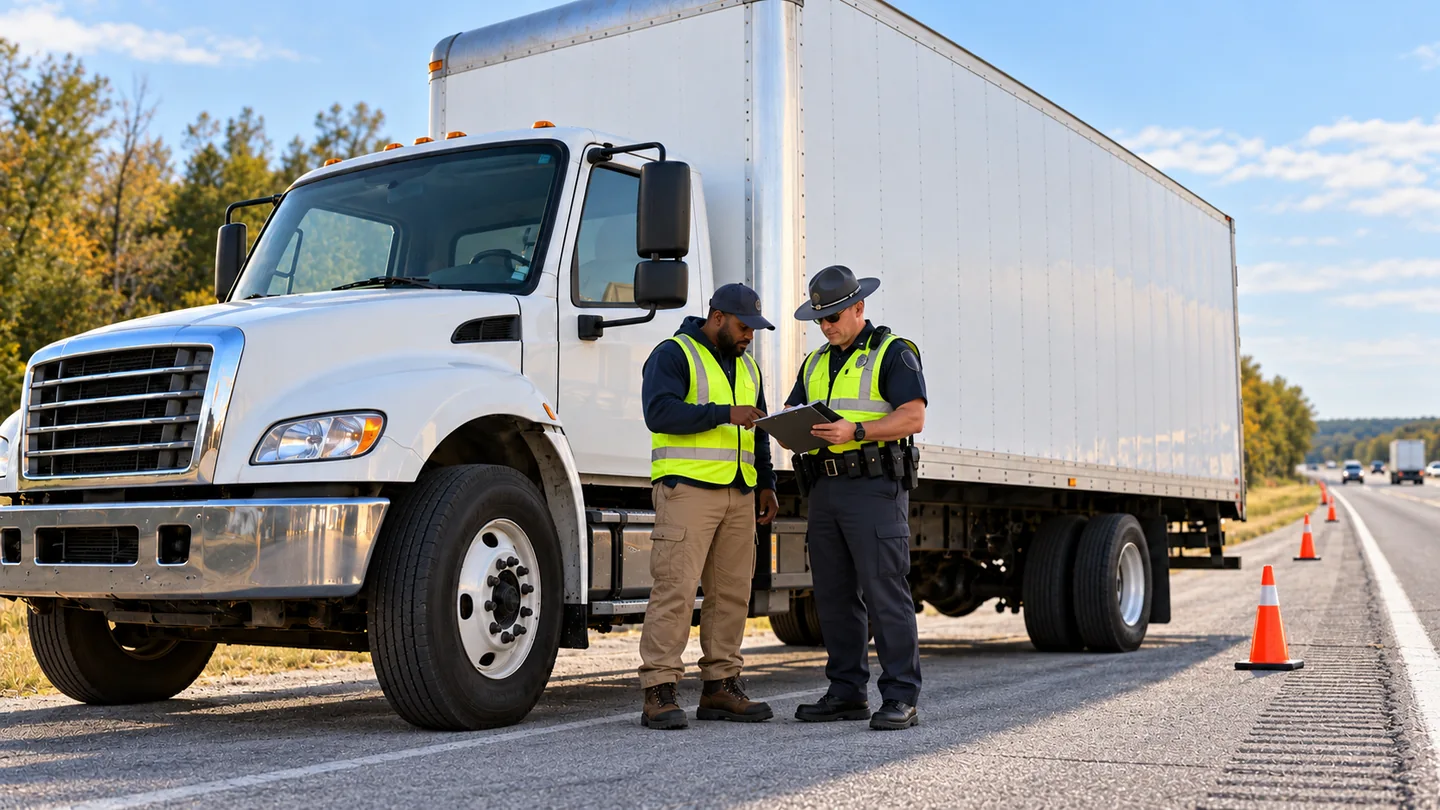
Original AI-generated editorial illustration created for this article. The scene does not document a real stop, violation, agency or specific inspection level. No endorsement implied.
By Mark. AI-assisted research and drafting, reviewed and approved by Mark. Read our standards.