
When Reckless Driving Becomes Box Truck Content
Celebrating unsafe shortcuts risks damaging the trust that responsible operators and serious newcomers work to earn.
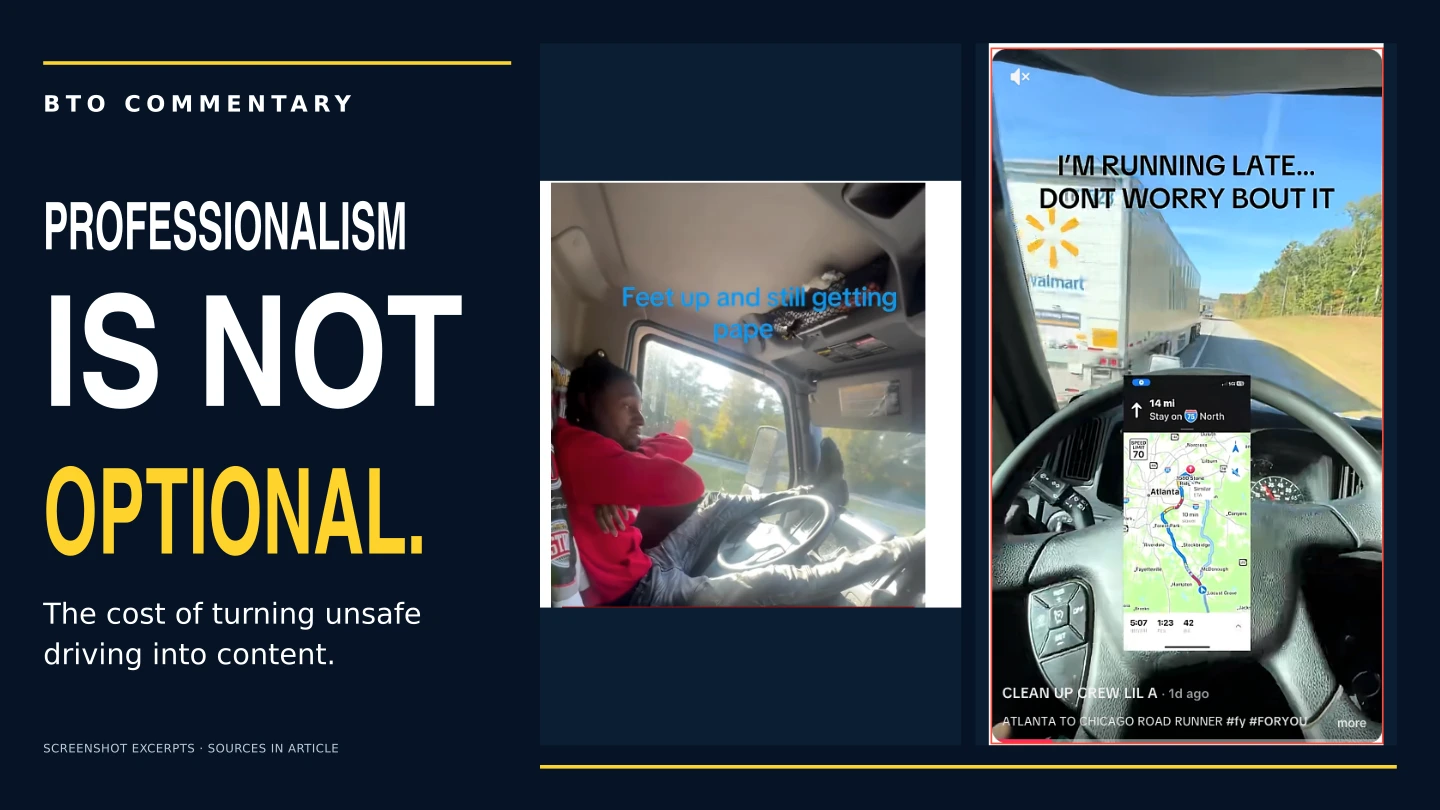
Over the past six years, since the pandemic, I have become increasingly concerned about the professionalism being displayed in parts of the box-truck business. From what I see in the content surrounding this industry, too much attention goes toward making the work look easy, showing off revenue, or turning poor judgment into entertainment.
That is my observation from following this industry, not a measured nationwide trend. It is a concern worth discussing because the standards we accept help shape the example we set.
The concern becomes serious when the performance for the camera reaches the driver's seat. Getting paid for a delivery does not make every decision along the way acceptable. A truck is operating around people who never agreed to become part of someone else's content.
What these images are selling
I watched two videos that brought this issue into focus. One showed a box-truck driver with his feet raised across the steering-wheel area while the vehicle was moving. His arms were folded. The caption read, “Feet up and still getting paper.”
In the other video, I watched a box-truck driver repeatedly use the shoulder to pass traffic. Its caption read, “I'M RUNNING LATE... DON'T WORRY BOUT IT.” The screenshots accompanying this commentary illustrate what I observed in those videos.
What bothered me was the way the behavior was presented. The captions made it look like something to brag about: getting paid with your feet up, or finding a way around the traffic everybody else was waiting in. That is a poor lesson to offer someone learning what this business requires.
I consider that conduct reckless, and it deserves criticism. The focus should remain on the choices, not personal insults, speculation about the individuals, or an attempt to turn two posts into a verdict on every box-truck operator.
The business depends on trust
A customer hiring a carrier is trusting that business with more than a shipment. The customer is relying on the operator to make sound decisions when nobody from the office is sitting beside them.
That matters when traffic backs up, a receiver runs late, a route becomes difficult, or a delivery window starts slipping. Those situations test whether someone can manage a business under pressure. A professional response may involve communicating a delay, revising the plan, or accepting that the original schedule cannot be recovered safely.
Consider a small operator trying to win a direct account. The proposal looks good. The equipment fits. Then the prospective customer finds a public post celebrating a dangerous shortcut. It is reasonable to expect questions about judgment, supervision, and whether that behavior would occur while carrying the customer's freight. An operator should consider that risk before making unsafe conduct part of their public image.
The wider concern is that some people may generalize from the most visible examples. A responsible operator should not have to answer for someone else's behavior. But dismissing the possibility that public conduct affects perceptions would be careless too.
New operators need better examples
People entering this business are trying to work out what success looks like. If the examples they encounter celebrate speed, shortcuts, and apparent ease, they can develop the wrong expectations before taking their first assignment.
A new operator may already have a thin business history and few references. Their job is to demonstrate that they can deliver consistently and handle problems responsibly. They do not benefit from an industry image that gives a customer another reason to hesitate.
I am concerned about the trust we risk losing, not claiming these posts have already caused higher insurance prices or tougher entry requirements. We should not normalize conduct that could undermine confidence in the people doing the work correctly.
There are operators planning routes, inspecting equipment, communicating with customers, and protecting freight every day. Their work may not produce a dramatic clip. It is still the example newcomers need to understand.
Pressure does not remove responsibility
Traffic, missed appointments, and delivery demands can create real frustration. A driver may worry about losing the next assignment or disappointing a customer. Recognizing that pressure is different from accepting a dangerous response to it.
If a delivery plan only works when someone takes unnecessary risks, the plan needs to change. Dispatchers, business owners, and customers should not reward results without asking how those results were achieved. An arrival time by itself does not tell the whole story.
The Federal Motor Carrier Safety Administration's safety guidance emphasizes staying focused, accounting for stopping distance, checking equipment, and planning around road conditions. It advises drivers to stop safely before attending to activities that take attention away from driving. Those are practical expectations for operating around other people, not optional extras for a company that wants to look polished. [1]
For an owner-operator, professionalism includes the willingness to make an uncomfortable call: “Traffic has changed my arrival time. Here is the updated estimate.” That conversation is part of managing the business. Trying to avoid it by creating another hazard is not a solution.
What we should expect from this industry
The standard should be clear enough that a first-time operator understands it. Remain positioned and attentive to control the vehicle. Use the road as directed rather than treating an unauthorized shoulder maneuver as a scheduling tool. Keep filming and content creation from interfering with driving. Address delays before they turn into desperate decisions.
Owners and dispatchers also have a role. Set realistic expectations, establish a process for reporting delays, and address unsafe behavior instead of celebrating a completed delivery at any cost. If you discover a problem in your own operation, correct the behavior and the conditions encouraging it.
Creators can help by showing what responsible work actually involves. A useful post might explain a difficult delivery decision, an accurate cost calculation, or how an operator handled a delay without making the situation worse. An audience can learn something valuable without watching someone gamble with control of a truck.
And when discussing a bad example, stay accurate. Do not turn criticism into harassment, invent a crash that never happened, or accuse a business simply because its equipment appears in the background. Accountability loses credibility when the response becomes careless too.
Protect the opportunity by respecting the work
The box-truck business can offer a legitimate path to business ownership. Preserving that opportunity means taking the work seriously, including the parts that will never attract an audience.
My concern about the direction of professionalism comes from wanting this space to be better. I want capable operators to earn trust and newer entrants to understand what they are stepping into. That requires more than teaching someone how to find an opportunity. It requires being honest about the responsibility attached to accepting it.
We do not need to condemn an entire industry to insist on better behavior. We need to stop presenting poor judgment as proof that someone has figured the business out.
The strongest example of success is a business that customers can rely on and an operator who gets the job done without making other people pay for their shortcuts.
Sources & editorial notes
This is commentary by Mark The Mentor, based on his firsthand viewing of the videos and his industry observations. It is not a statistical finding about industry-wide trends. AI-assisted drafting; reviewed and approved for publication by Mark The Mentor. Read our standards.
Image credit & context
Screenshot excerpts: YouTube post and TikTok post, supplied and reviewed by Mark The Mentor. Layout by BTO; original screenshots proportionally resized, not AI-reconstructed. Used to illustrate the conduct discussed; no endorsement implied.
Source-post ownership and recording dates have not been independently established. The excerpts are included for criticism and commentary; BTO does not claim a license or endorsement from the original creators. Incidental third-party branding does not identify the operator responsible for the conduct. The cover is a designed collage, not a single photograph.