
Reported Motus suspensions put carrier registration checks in focus
Recent reporting raises business-continuity questions; an older federal filing notice addresses a different issue.
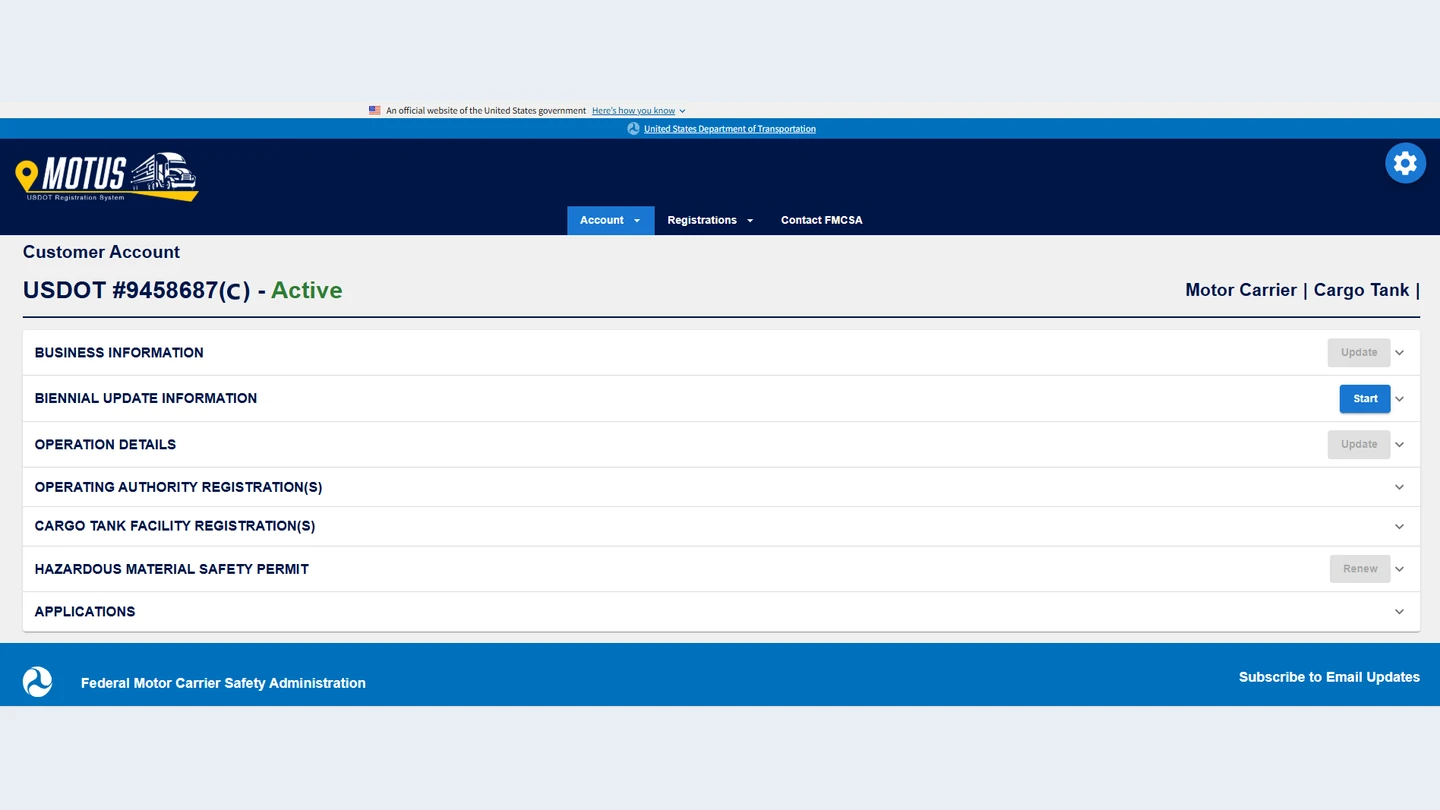
Original report: October 29, 2026; updated October 30. Reported carrier discovery: October 27. BTO publication and expansion: October 31.
An unexpected change in a federal registration record can become a business problem before an owner understands what changed. Recent reporting about Motus, the Federal Motor Carrier Safety Administration’s registration system, illustrates why a carrier needs to know what its records say—and how those records compare with its actual operation.
What the Illinois carrier reported
Commercial Carrier Journal reports that Dynamic MD, a flatbed and step-deck carrier based in Carol Stream, Illinois, discovered on October 27 that Motus classified it as a hazardous-material carrier and showed an involuntary suspension. Jason Cannon’s report was published October 29 and updated October 30. [1]
According to that reporting, the classification raised the required liability amount to $1 million while the filing showed $750,000. The carrier’s president told CCJ the business actually carried $1 million in auto coverage, but could not book shipments and could not use the reinstatement option shown in the system. Those are reported circumstances, not records BTO independently inspected. [1]
BTO has not interviewed the carrier, reproduced CCJ’s wider data analysis or established whether this particular problem has since been resolved. The report concerns a flatbed operation; it does not establish how many box-truck or cargo-van businesses have encountered the same issue.
Why the classification and the filing both matter
FMCSA says insurance requirements depend on the entity, authority, cargo and vehicle involved. Its published chart distinguishes non-hazardous for-hire property carriers from certain hazardous-material operations. For non-hazardous property carriers with a GVWR of at least 10,001 pounds, the chart lists $750,000 in bodily-injury and property-damage liability; certain hazardous-material categories require $1 million or more. These are category-specific requirements, not a new blanket rule for every delivery business. [3]
The agency also says a financial-responsibility provider files the appropriate forms on an applicant’s behalf and that entities must keep required proof on file. The policy a business purchased and the filing reflected in a registration record therefore deserve separate attention. [3]
Do not use those figures to decide that a particular box truck, cargo van or household-goods operation needs only the amount shown in one row. Applicability and customer contracts need their own review. This article does not determine an individual carrier’s required coverage.
Motus and older records can tell different stories
FMCSA describes Motus as the system for applying for and managing registrations, updating company information and tracking registration actions. Its public-user guidance also provides for searching an entity’s registration record and viewing daily registration decisions. [4]
There is an important limitation in the agency’s May 21 FAQ: the older Licensing and Insurance system is available for historical motor-carrier records, and Motus filings are not reflected there. That makes the system and date behind a result important. A saved page or familiar legacy link should not automatically be treated as the latest record. [5]
If two screens disagree, preserve both with their dates and identify the field in dispute. Do not assume a historical entry proves a current suspension is wrong—or that a current warning explains every earlier filing. BTO did not use a legacy screen to clear Dynamic MD or any other carrier.
The biennial-update notice is a separate issue
FMCSA’s notice, last updated September 10, gives additional time for biennial updates due on or after June 1, 2026 and says those registrants will not have their USDOT numbers inactivated for failing to complete that update. That is relief concerning the biennial filing. The notice does not announce a remedy for the insurance-record issue in CCJ’s report. [2]
An owner should identify the actual reason attached to a notice instead of treating all Motus problems as the same problem. A filing deadline, an insurance discrepancy and an authority-status question can require different evidence. An unrelated extension does not settle all three.
What operators should check
BTO analysisStart with a dated record check rather than a general assumption that the business is fine because its policy renewed. Compare the legal name, USDOT and docket identifiers, operation and cargo classifications, authority status, and insurance information against the business’s own documents. Record which system supplied each result.
For the insurance comparison, separate the amount shown as required from the amount shown as filed, and check the effective dates. Ask the insurance provider to identify what was filed and for which entity. A certificate sent to a customer is not, by itself, confirmation that every federal record reflects the same information.
If something conflicts, assemble a concise evidence packet: the dated screen, the field that appears wrong, the relevant policy or filing information, and any notice or case reference already received. Use FMCSA’s official registration support route and the insurance provider as appropriate. Keep a timeline of responses and retain the result of any correction. This is an operating approach, not a guaranteed reinstatement procedure.
Do not assume an open support ticket, a screenshot or an insurance payment restores authority. Resolve what the record means for the specific operation before treating the business as cleared. A dispatch deadline does not answer a registration question.
Build record checks into business continuity
For a one-truck business, an administrative interruption can affect the same cash used for fuel, helper pay, rentals and other commitments. The lesson is to give record checks an owner and a routine place in the business, especially around insurance renewals or changes to company information. That recommendation is BTO analysis, not a federal inspection schedule.
The reporting warrants attention without turning one carrier’s experience into a claim that every small fleet is suspended. What operators can control is the quality of their own records, the evidence they retain and how promptly they investigate a discrepancy. Whether the reported Motus problem has been corrected, and its verified effect on box-truck businesses, remain unresolved in this review.
Sources & reporting notes
- Jason Cannon, Commercial Carrier Journal: original reporting, October 29, 2026; updated October 30. ↗
- FMCSA: Temporary Suspension of the Biennial Update Requirement, updated September 10, 2026. ↗
- FMCSA: Insurance Filing Requirements, updated March 26, 2026. General requirements/chart; older transition instructions are not a current filing walkthrough. ↗
- FMCSA: Move into Motus, registration-management and public-user capabilities; undated page checked October 31. ↗
- FMCSA: AskFMCSA insurance FAQs; May 21, 2026 entry on historical Licensing and Insurance records. ↗
Sources checked October 31, 2026. CCJ’s original reporting is credited; no interview, affected-carrier record audit or independent reproduction of its data analysis was performed by BTO. Federal guidance and BTO operating analysis are distinguished above.
AI-assisted research and drafting by BTO Editorial. Approved for publication by Mark The Mentor. Read our standards.
Updated October 31, 2026: expanded the reporting context, federal-source explanations and practical operating checks; added an official FMCSA Motus training screenshot. Original publication date retained. Cover subsequently replaced with a Motus-specific FMCSA training screenshot at Mark’s request.
Image credit & context
Image: FMCSA Office of Registration · May 2026 training screenshot · U.S. government work, public domain (17 U.S.C. § 105) · Resized for display. Extracted from page 2 of “Navigating Your Company Account in Motus.” The source interface image was extracted from the guide; surrounding instructions and overlay callouts are omitted, and neutral padding was added to match the cover format. This is not a photograph, a current live account or a depiction of the reported suspension. Agency branding identifies the system being reported on; no endorsement implied.